When students and pro-democracy activists took to the streets of Jakarta and other major cities in Indonesia on May 20, 1998, and afterward rejoiced over the fall of Suharto’s authoritarian regime, they never thought that a global pandemic would pose such a significant threat to democracy. In Indonesia, more than two decades later.
After 22 years, we can all hope that the danger is over, Indonesia’s democracy can finally be consolidated and eventually become an “only game in town.”
Yet, here we are today, worrying about the state of our democracy today. As we comply with stay-at-home orders, we are becoming increasingly concerned about whether the COVID-19 pandemic has become a cover for the authoritarian instincts of the current political leadership.
The government of President Joko Widodo “Jokowi,” who was directly re-elected for a second term in 2019, has indeed not chosen the path followed by the leaders of some of the world’s populist regimes, which have overturned democratic rules and norms and used iron fist power in their power, which they claim can help deal with the pandemic more effectively.
But as COVID-19 has damaged Indonesia’s economy and placed significant pressure on the country’s healthcare system, President Jokowi has taken steps that could undermine the basic foundations of democracy and the rule of law in recent weeks.
Regulation in place of Law (Perppu) No. 1/2020 is the first significant sign of the country towards a democratic deviation. Not only has the state budget deficit exceeded the legal limit of 3 percent of Gross Domestic Product, but officials who spend on programs related to COVID-19 will also be protected from criminal charges of “not being a state loss.” This includes policies in the field of taxation, regional finance, which are part of the national economic recovery. This lack of accountability from Suharto’s New Order regime brought students and activists to the streets in the late 1990s.
There has also been an increase in efforts to silence criticism of the government during the COVID-19 pandemic. In late April, independent public policy researcher Ravio Patra was dragged from a restaurant in Menteng, Central Jakarta, and sent to the Metro Jaya Regional Police after tweeting and critically writing government policies. Ravio’s arrest follows a series of harsh measures the police took in dealing with grassroots activist initiatives.
In recent days, we have also learned that even on issues not related to COVID-19, the central government has taken steps to accumulate more power. Government Regulation (PP) No. 17/2020 on the Management of Civil Servants grants the President full powers and arbitrary powers to promote, demote or fire any Civil Servant. Amendments to the 2009 Coal and Mineral Mining Law are the formalization of the authority to issue permits for mining operations, which are reported to be for the benefit of the coal barons.
Until the coronavirus first hit, we used to believe that democracy could die because of a military coup, the emergence of a populist leader, or the takeover of another ideology. However, with more and more governments following their authoritarian instincts during this pandemic, we could soon see democracy withering away in silence and darkness.
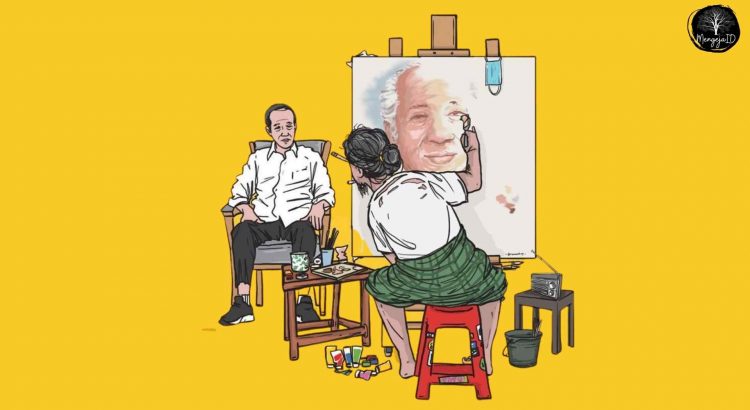
Image source: Brambot Kusuma (Instagram/@brambotkusuma)